In an era of increasing social and environmental responsibility, B Corp certification stands as a gold standard for businesses committed to doing well by doing good. For accounting firms, achieving this certification not only validates your commitment to sustainable and ethical practices but also sets you apart in a competitive market.
However, the journey to B Corp certification is far from straightforward. This blueprint aims to serve as a comprehensive guide for senior accounting professionals who are eyeing this coveted certification.
Each chapter offers a structured approach, complete with introductory context, why each step matters, actionable insights, and tools to help you execute your plan. The goal is not just to guide you through obtaining a B Corp certification but also to foster a culture that genuinely embraces sustainable and ethical practices.
Chapter 1: Research and initial assessment
Navigating the path to B Corp certification starts with a comprehensive understanding the specific challenges your firm faces. By conducting a robust initial assessment, you will identify the areas in your operation that require the most attention. Think of this phase as your reconnaissance mission—where you gauge your readiness and lay the groundwork for an informed action plan.
This chapter provides a roadmap for conducting that initial self-audit, offering guidance on what to focus on and how to go about it.
Why it matters
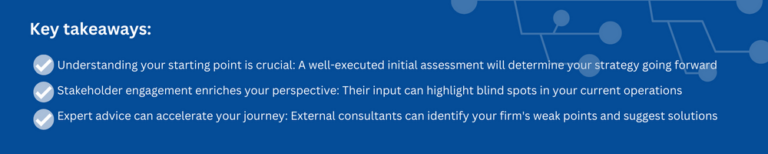
Before you can plot a course to your destination, you need to know your starting point. Initial assessment is the compass that helps you navigate the labyrinthine process of B Corp certification. It equips you with the insight to tailor your strategy, pinpointing the changes you will need to make in operational, governance, and ethical aspects. Without this foundational understanding, your quest for certification might be akin to sailing without a compass—unfocused and inefficient.
How to execute
- Conduct an internal audit: Use existing frameworks or templates to perform a self-audit of your company’s practices across multiple dimensions like governance, environmental sustainability, and social responsibility
- Engage stakeholders: Invite your employees, partners, and even customers to give their input on your firm’s current practices, as their insights can be invaluable
- Consult external experts: Consider hiring consultants with B Corp experience to assess your readiness and offer recommendations
Tools/resources
- B impact assessment sample questions: Familiarise yourself with the kind of queries you’ll face in the actual assessment
- Internal audit templates: Pre-designed templates can help structure your internal review process
- B Corp consultancy firms: A list of consultancy services specialising in B Corp certification can provide expert guidance.

Chapter 2: Planning
The road to B Corp certification is like a complex orchestra—every instrument has its role, and every musician must be in sync to create a harmonious sound. After the initial assessment, the planning phase serves as your sheet music, coordinating all aspects of your business to work in unison towards achieving the certification. Whether it’s aligning your internal resources or setting up realistic timelines, planning is the backbone of your certification journey. In this chapter, we delve into how to create an action plan that is both strategic and feasible.
Why it matters
The intricacies of B Corp certification extend far beyond filling out an application form. Changes might need to be made in your operations, corporate governance, and even your company’s bylaws. Failure to plan is planning to fail, as the adage goes, and that is particularly true here. A well-laid-out plan serves as your playbook, ensuring that every department knows its role and can act in a coordinated fashion, thereby saving time and resources in the long run.
How to execute
- Set objectives and KPIs: Clearly define what you want to achieve through B Corp certification and how you will measure success
- Allocate resources: Determine the human capital and financial resources you will commit to this journey
- Create a timeline: Develop a detailed timeline that includes key milestones, ensuring everyone knows the deadlines for each phase of the process.
Tools/resources
- Gantt chart software: Tools like Microsoft Project or Asana can help you visualise your project timeline
- B Corp certification planner: Some consultancy firms offer specialised planning tools designed for the B Corp application process
- Internal communication platforms: Use Slack or Microsoft Teams to establish dedicated channels for regular updates, aligning everyone involved in the process.

Chapter 3: Operational changes
No journey towards B Corp certification is complete without tangible shifts in how your business operates. These changes aren’t just about ticking boxes but about creating a culture of sustainability and responsibility that permeates every layer of your organisation. Think of this phase as re-tuning your orchestra: each adjustment may be minor, but collectively, they create a significant impact. In this chapter, we focus on the operational adjustments necessary to align your firm with B Corp principles.
Why it matters
Operational changes are the crux of the certification journey; they are where the rubber meets the road. The B Corp certification is more than a badge—it is a statement of your company’s values and practices. Failing to enact meaningful operational changes is akin to putting up a façade. Genuine alterations are not only imperative for certification but also beneficial for long-term business sustainability and stakeholder relationships.
How to execute
- Map out operational elements: Identify the specific areas in operations, like supply chain management or energy usage, that need changes
- Develop new protocols: Create or adapt existing protocols that better align with B Corp standards
- Train employees: Ensure that the staff is adequately trained and aware of the new operational standards.
Tools/resources
- Change management software: Platforms like Monday.com can help you track and manage operational changes efficiently
- Sustainability auditing tools: Software like SustainIt can help assess your sustainability measures
- Employee training platforms: Tools like TalentLMS can be customised to educate your team on the new protocols.

Chapter 4: Application process
Reaching the application phase is a major milestone in your journey to B Corp certification. This is where you gather all the fruits of your labor—the operational adjustments, the planning, and the initial assessments—and put them to the test. Picture this phase as the dress rehearsal before the grand orchestra performance. Your application isn’t just a set of forms; it’s a comprehensive document that reflects your commitment to social and environmental responsibility. In this chapter, we demystify the nuts and bolts of filling out and submitting your B Corp application.
Why it matters
The application isn’t just a formality—it’s the gateway to your certification. A poorly prepared application can negate all the hard work invested in planning, operational changes, and initial assessments. Consider this phase as the crucible where your readiness is truly tested. The quality of your application is a reflection of your firm’s earnestness and capability in living up to B Corp standards.
How to execute
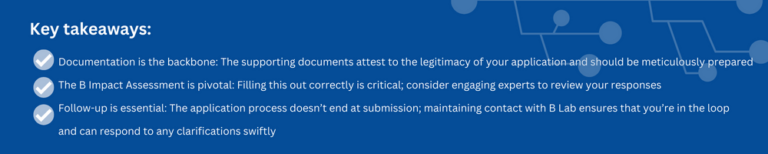
- Compile necessary documentation: Collect all required documents, such as policy papers, governance structures, and evidence of operational changes
- Complete the B Impact Assessment: The core of the application, this assessment gauges your firm’s overall positive impact
- Submit and follow up: Once complete, submit your application and keep track of its status. Be prepared for additional queries or clarifications
Tools/resources
- B Impact Assessment Portal: The official platform where you will fill out and submit your application
- Document management software: Tools like Dropbox Business or Google Drive can help you organise the required documents effectively
- Application consultancy services: Hiring a consultant specialised in B Corp applications can provide valuable insights and improve your application’s quality
Chapter 5: Legal requirements
While the focus so far has been largely on operational adjustments and the application process, legal compliance serves as the keystone of your B Corp journey. This phase is akin to crossing the ‘t’s and dotting the ‘i’s in your musical score; it might seem minor but is absolutely essential for the performance to be flawless. From modifying your governance structure to ensuring adherence to statutory norms, this chapter outlines the critical legal steps you need to take to meet B Corp requirements.
Why it matters
Legal compliance is not merely a box to check; it underpins your entire B Corp venture. The B Corp certification has stringent legal standards to ensure that your commitment to doing good is hardwired into the DNA of your company. Inadequate legal preparations could result in your application being rejected outright, no matter how robust your operational changes and planning have been. This stage fortifies your firm’s commitment to being a long-term advocate for ethical and sustainable business practices.
How to execute
- Review governance structure: Examine your existing legal governance model and adapt it to integrate B Corp principles
- Legal documentation: Update company bylaws, shareholder agreements, and other key documents to reflect B Corp compliance
- Engage legal help: Consult legal professionals well-versed in B Corp requirements to guide you through the legal intricacies.
Tools/resources
- Legal templates: There are templates available tailored for B Corp legal requirements that can provide a baseline for your documents
- Legal consultancy firms: Consultancies specialising in B Corp can provide focused legal guidance
- Compliance software: Software like ComplianceBoard can help you keep track of all legal requirements and deadlines.

Chapter 6: Certification and beyond
Congratulations! By reaching this point, you are on the brink of an important milestone, but it is crucial to understand that B Corp certification is not the final destination—it is the starting line. Think of your certification as the grand finale of the orchestra performance; it marks a successful culmination but also sets the stage for future symphonies. In this chapter, we explore what comes after you receive the B Corp badge and how to make the most of this prestigious certification.
Why it matters
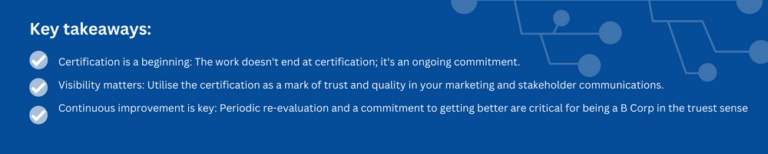
Being a B Corp is not a one-time accolade but a continuous commitment to social and environmental excellence. The certification brings along responsibilities and expectations that are integral to maintaining the reputation and benefits that come with the badge. Beyond the certificate itself, the real value lies in living the B Corp ethos in every aspect of your business, from daily operations to long-term strategies.
How to execute
- Announce and celebrate: Make the certification known through internal and external channels, celebrating this milestone with your stakeholders.
- Integrate B Corp values: Make sure that the B Corp principles are integrated into your strategic planning and daily operations moving forward.
- Regular assessments: Continue to undergo periodic assessments to maintain and improve your B Corp status.
Tools/resources
- Communication platforms: Utilise social media, press releases, and internal newsletters to announce the certification.
- Sustainability dashboards: Platforms like Metrio allow you to monitor your ongoing social and environmental performance.
- Continuous learning resources: The B Corp community provides resources for continued best practices and community engagement.
In this blueprint, we have delineated a systematic approach for accounting firms to achieve B Corp certification—a prestigious marker of social and environmental responsibility. But this is not just about securing a certification; it is about embedding a culture of responsible business that benefits not just your bottom line but also society and the environment at large. Skipping or undermining any of these crucial steps can not only jeopardise your chances of certification but can also weaken the very ethos that B Corp aims to promote.
In an increasingly conscious business environment, attaining and maintaining B Corp certification can set you apart as a leader in corporate responsibility, building lasting value for your firm and all its stakeholders.