The landscape of accounting is undergoing a major shift, powered by advancements in AI and automation. These technologies are transforming how firms operate, with 2025 set to be a year where tech-driven growth becomes a necessity rather than an option.
According to the latest 2025 Intuit QuickBooks Accountant Technology Survey, which gathered insights from 700 accounting professionals, the role of accountants is evolving rapidly.
AI and automation are no longer buzzwords; they are tools that enhance productivity, reduce stress, and help firms scale more effectively.
AI: A Daily Driver for Accountants
Artificial intelligence is now embedded in the day-to-day operations of accounting firms. In fact, 46% of accountants report using AI every day, a significant leap compared to just 28% of small businesses adopting the technology.
This widespread adoption demonstrates that AI is no longer a novelty; it is becoming integral to the profession.

Key findings on AI’s impact:
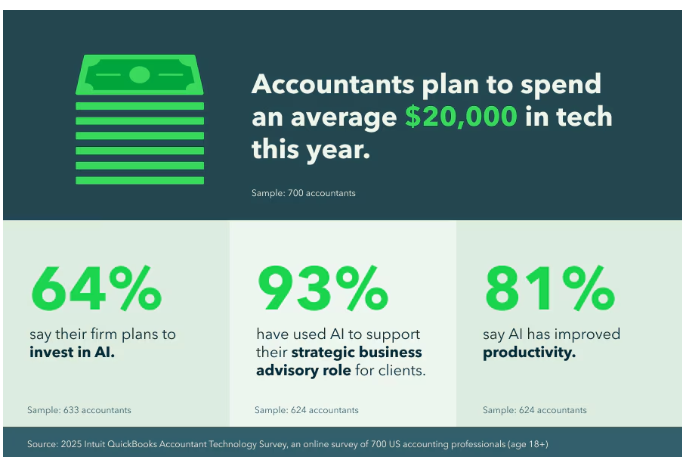
- 81% of accountants report that AI boosts productivity.
- 86% agree that AI helps reduce their mental load, making their work more manageable.
- 93% use AI in strategic advisory roles, underlining its importance in value-driven client services.
This shift is reshaping the profession, allowing accountants to move away from purely compliance-based tasks and focus on higher-value, strategic advisory services.
Strategic Advisory on the Rise
As compliance tasks become more streamlined through AI and automation, accountants are increasingly dedicating time to advisory services.
79% of accountants anticipate growth in strategic advisory services within the next year, with the volume expected to rise by an average of 38%.
This shift is not just about increasing service offerings; it’s about adapting to a competitive landscape where firms must innovate to retain high-value clients.
Key drivers of advisory growth:
- 95% of accountants say technology has helped reduce time spent on compliance tasks, freeing up resources for strategic work.
- 94% agree that growing the advisory side of their business will directly boost revenue.
- 89% of accountants believe expanding advisory services will improve client relationships and satisfaction.
Firms that effectively embrace this shift are positioning themselves not just as service providers but as trusted business advisors to their clients.
Technology Investment: The Key to Unlocking Growth
Technology adoption is no longer optional—it’s a key driver of growth. Accounting firms are increasingly dedicating their budgets to technology, with firms planning to spend an average of $20,000 on tech in the coming year, up from $19,000 last year.
Top priorities for technology investment:
- 64% of firms plan to invest in AI.
- 45% of firms are focusing on automation.
- 40% are investing in marketing applications to further drive growth.
This increased spend is driven by the clear benefits that automation and AI bring to accounting firms.
95% of accountants have adopted automation to streamline processes, such as payroll and accounts payable, with 98% reporting improved data accuracy and workflow efficiency as top benefits.
Managing Overcrowded Tech Stacks
While the adoption of multiple technologies is essential, it also presents a challenge: integration. Accountants report managing an average of 8 different digital tools, and 89% of firms believe better integration is key to unlocking their full potential. The complexity of managing several disconnected systems is overwhelming for many firms.


Key insights:
- 66% of accountants admit feeling overwhelmed by their tech stacks at least weekly.
- 36% of firms have fully standardized their tech stacks to ensure better integration across their practice and clients.
Standardizing technology is proving to be a crucial strategy for efficiency. It reduces friction and increases accuracy, enabling firms to focus more on delivering high-quality client services and less on managing disparate systems.
Client Tech Adoption Drives Demand for Expertise
As firms adopt more sophisticated tech, their clients are doing the same. 83% of accountants believe that high-value clients are more likely to be tech-advanced, which creates a competitive dynamic for firms.
For accountants, staying ahead in tech is not just a matter of internal capability; it’s about meeting the rising expectations of clients who are increasingly digital-first.
Client adoption of technology:
- 52% of clients are considered tech-forward, with 25% using cutting-edge technology for a competitive advantage.
- 79% of accountants expect increased competition for high-value advisory clients in the coming year.
As client tech adoption grows, accountants must stay ahead of the curve, offering the right solutions to help businesses navigate their digital transformation.
The Talent Challenge: Navigating the Skills Gap
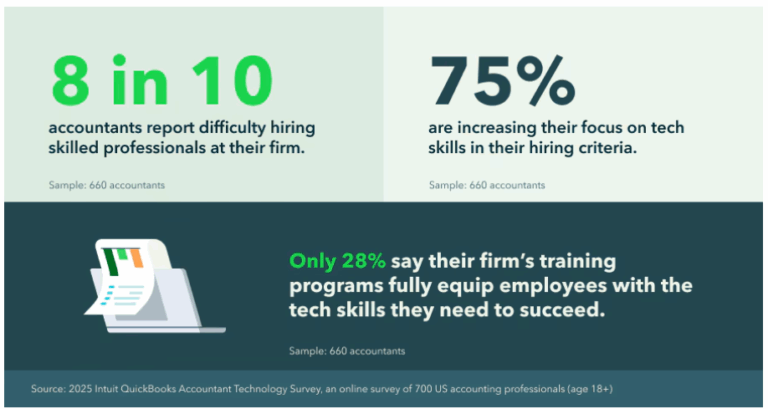
Despite the growing reliance on technology, the profession is grappling with a talent shortage. 80% of accountants report challenges in hiring skilled professionals, particularly those with expertise in technology.
Recruiting candidates with a combination of technical and accounting skills is proving increasingly difficult.

Key recruitment challenges:
- 42% of respondents struggle to secure junior candidates with more than one year of experience.
- 75% of firms are increasingly focusing on hiring for technology skills, but 28% feel that current training programs are insufficient to meet the technological demands of the profession.
To bridge this gap, firms need to prioritise upskilling and invest in comprehensive tech training programmes that will prepare their staff to handle the increasing complexity of digital tools.
Outsourcing: A Strategy for Strategic Focus
With the increasing demand for more value-driven services, 80% of accountants have outsourced accounting services in the past year. Outsourcing has become a vital strategy to scale operations while focusing on high-value client work.
For firms, this trend is expected to continue, with 83% of accountants agreeing that outsourcing gives them a competitive edge.
Top outsourcing areas:
- 36% of firms outsourced financial statement preparation.
- 34% outsourced general ledger and transaction management.
Outsourcing allows firms to shift their focus towards strategic advisory services while managing growing workloads efficiently.
The Tech-Driven Future of Accounting
The future of accounting is undeniably tech-driven. As AI and automation continue to reshape the profession, firms that leverage these technologies will have the tools they need to drive growth, improve productivity, and deliver higher-value services to clients.
However, this technological transformation also requires overcoming integration challenges, tackling the talent gap, and staying ahead of client expectations.