No early Christmas gifts from Threadneedle Street, but next rate move most likely down
MPC remains hawkish, but rates have likely peaked
MPC remains hawkish, but rates have likely peaked

The Bank of England’s Monetary Policy Committee (MPC) kept interest rates unchanged at 5.25% for the third consecutive meeting in December. The vote remained 6-3, with three members preferring a quarter-point rate hike. The committee continued to maintain a tightening bias, suggesting that ‘Further tightening in monetary policy would be required if there were evidence of more persistent inflationary pressures’.
Before last week’s meeting, financial markets had already moved to expect several quarter point rate cuts from the MPC in 2024, with the first assumed to come by the end of June at the latest.
Wednesday’s much more dovish than expected US Federal Reserve (Fed) meeting likely encouraged excitement in some quarters that a similar pivot may have been in the offing for the MPC.
The median expectation for US interest rates among Fed members for the end of 2024 dropped to 4.6% in their latest projections, from 5.1% in September, consistent with three quarter-point interest rate cuts in 2024. In the press conference, Fed Chair Jerome Powell acknowledged that the committee had discussed the possibility of future rate cuts, with officials seemingly becoming more confident in the economy’s chances of achieving the much talked about soft landing.

The MPC maintained a decidedly hawkish posture though (as did the European Central Bank). This reflects the widely differing economic situations in the two countries, with the UK currently experiencing a far inferior growth and inflation mix than its US counterpart.
In the first three quarters of 2023, UK growth was much weaker than in the US (Chart 1). Despite this, UK inflation is significantly higher (Chart 2) and measures of domestically-generated inflation remain very elevated, despite some signs of moderation, with services inflation at 6.6% and wage growth over 7%. The UK’s less salubrious mix of growth and inflation reflects its greater exposure to the recent European energy price shock, as well as damage to the economy’s supply-side since Brexit.
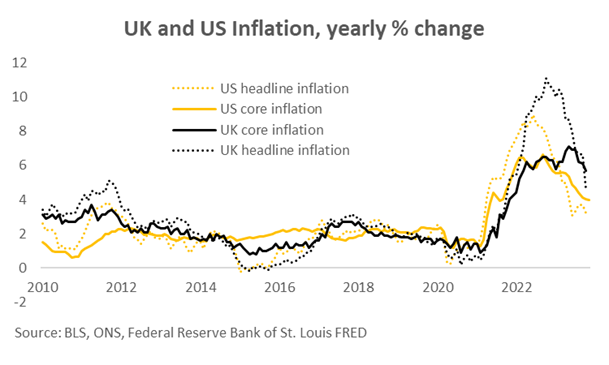
With headline inflation currently more than double the MPC’s target, stubborn underlying inflation, and a still tight labour market despite signs of easing, Governor Bailey would not have wanted to signal that the MPC was even considering rate cuts at the present time. The committee will want to see much more evidence that price pressures and wages are heading down to levels consistent with inflation moving sustainably back to target.
Moreover, it will be keen to observe the outcome of the upcoming Budget, where further tax cuts from Chancellor Hunt seem likely ahead of the election, as well as the broader impacts of the large increase in the National Minimum Wage due in April.
Despite the Bank of England’s restraint, absent a spike in oil prices or other supply shocks, it would seem most likely that we have seen the peak in interest rates.
Moreover, with growth likely to remain extremely weak amid restrictive monetary policy (Chart 3) and a subdued global economy, and with inflation likely to come down materially further over the next several quarters, it would seem broadly sensible to assume that the MPC may begin a very gradual pace of monetary easing in the second half of 2024, perhaps beginning in August. Even then, policy will likely remain well into restrictive territory.

All in all, 2023 has been a challenging year for the UK economy, and 2024 is squaring up to be more of the same. The MPC did not come bearing Christmas gifts at its December meeting, but long-suffering households and businesses are unlikely to have to wait till the next festive season for rate cuts.
Meanwhile, if the Fed is successful in pulling off a soft landing for the US economy and begins to ease monetary policy, that should bring some extra cheer to the global economy in 2024.