Navigating the new normal: The strategic turn to outsourcing in R&D tax services
Amidst complex regulations and a crackdown on fraud, UK accounting firms are increasingly turning to outsourcing as a strategic approach to ensure compliance and leverage specialised expertise in R&D tax services.
Brought to you in partnership with Source Advisors, previously known as GovGrant in the UK.

In the evolving landscape of UK R&D tax services, firms are increasingly embracing outsourcing as a strategic move to navigate complex regulations and harness specialised expertise.
While the field has indeed become more challenging with intensified compliance and a crackdown on fraud and erroneous claims, this has also opened doors to innovative solutions and partnerships.
A decade ago, R&D tax services were perceived to be more straightforward, managed primarily in-house with a general tax knowledge approach. However, the landscape has significantly changed, becoming more intricate with detailed documentation requirements and closer HMRC scrutiny.
“Historically, many accountants have been comfortable supporting clients by preparing R&D tax credit claims internally,” explains Vicki Morrall, Accounting Partner Director at Source Advisors. “Questions are now being asked – is this sufficient and do accountants have confidence that those claims are compliant?”
This shift has not deterred firms but instead inspired a dynamic approach – embracing external expertise to enhance service quality and compliance assurance. Outsourcing is now seen as a strategic asset rather than a stigma, allowing firms to access a pool of specialised knowledge, particularly beneficial in dealing with the nuanced aspects of R&D tax relief claims.
“Accountants will, of course, want to continue to support their clients fully. If they are no longer confident that they can offer a fully compliant service, then third-party specialists offer a viable alternative to withdrawing an R&D service completely,” says Morrall.
These external specialists are not just a response to regulatory demands; they bring value-addition through their deep industry-specific expertise, ensuring accurate, compliant, and – optimised claims.
A move in the right direction
The move to outsource is driven by pragmatism and a positive vision for the future. By partnering with the right specialists, firms can navigate the complexities of R&D tax relief claims confidently, freeing up internal resources to focus on core business strategies and client relations.
“R&D specialists keep a close eye on any developments to the R&D tax relief schemes, it’s their core business and how they bring their expertise and experience to bear. However, many accountants may decide that keeping on top of this ever-shifting landscape of rules and regulations has ceased to be viable,” says Morrall.
By outsourcing to specialists, accounting firms can tap into a pool of professionals with diverse backgrounds and qualifications. These specialists can provide valuable insights and ensure accurate and compliant claims.
Another advantage of outsourcing is risk reduction. The heightened scrutiny from HMRC has resulted in more frequent disputes over technical interpretations in claims submitted. By partnering with outsourcing firms that have a thorough understanding of the legislation, accounting firms can mitigate the risk of making ineligible claims. This not only protects their clients but also safeguards their reputation and minimises potential penalties.
Resources & Whitepapers
Accounting Software The power of customisation in accounting systems
“Clients can be safe in the knowledge that should a compliance enquiry be opened, it will be dealt with promptly, efficiently, and appropriately by a third-party specialist. Most reputable R&D providers will discuss arrangements for defending a claim they have prepared, including an option of providing that service free of charge,” says Morrall.
A strong partnership requires open and transparent communication channels, as well as a shared commitment to delivering exceptional client service.
Ensuring the right fit
Choosing the right outsourcing partner is pivotal. Firms should look for partners with proven expertise, integrity, and a commitment to enhancing the firm’s offering. It’s not just about compliance; it’s about adding value.
When considering outsourcing R&D tax services, accounting firms should carefully evaluate potential partners. The selection process should take into account several factors to ensure a successful collaboration. One of the key criteria is experience.
It is important to choose a partner with a proven track record in handling R&D tax claims and a deep understanding of the industry. Accounting firms should look for partners that have successfully navigated complex cases and have a strong reputation in the field.
Morrall says any partner should have “demonstratable technical and financial expertise in compiling R&D claims and confidence that those claims could withstand tough scrutiny”. This should include a range of commercial and technical experts who can identify and substantiate qualifying R&D activity.
In addition, Morrall says partners should be able to show a long-term commitment to the “integrity” of the R&D tax relief schemes. This is “in contrast to the providers who […] were notable in promoting R&D tax relief as ‘free money’ to any business,” she says.
Credibility is another important factor to consider. Accounting firms should seek partners who are recognised and trusted within the industry. This can be assessed through client testimonials or referrals, recommendations, and case studies. It is also crucial to assess the partner’s compliance with relevant regulations and standards to ensure ethical practices and data security.
Then there is the question of the value add – can a provider enhance a firms’ offering to clients. Morrall says a good partner should be able to: “Some R&D specialists can offer a wider IP offering. IP expertise brings the particular benefit establishing the technical baseline, a compelling proof point to an R&D claim. But beyond that IP expertise could support your clients’ Patent Box claims and go further to help your clients identify their IP assets and then transform them into tangible commercial value.”
Alignment with the firm’s needs and values is also essential for a successful outsourcing partnership. Accounting firms should evaluate whether the partner’s approach aligns with their own business objectives and values. This includes considering factors such as communication style, responsiveness, transparency and cultural fit.
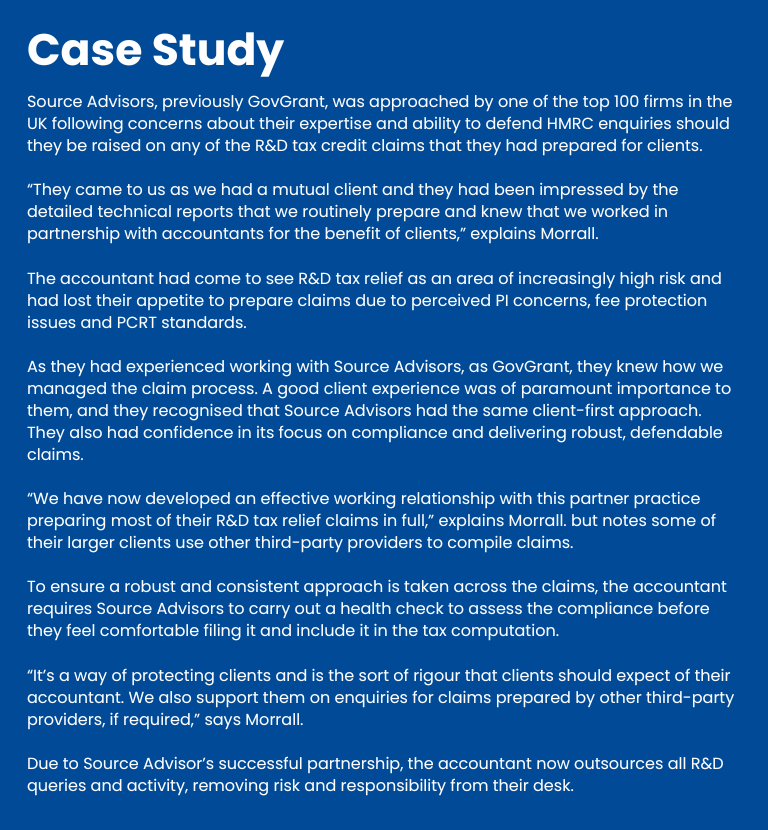
What does 2024 have in store?
Plans for a single R&D tax relief scheme, which merges the SME and RDEC schemes, are confirmed to go ahead for accounting periods starting on/after April 2024. This does at least give accountants some certainty on timelines.
“With these latest announcements the Treasury is now ending its review into the R&D tax reliefs, concluding a two-year review into the competitiveness of the UK’s R&D incentives,” says Morrall.
“[The] Treasury has concluded that the R&D reliefs are fit for purpose, however, hint to further work on tackling non-compliance with HMRC to release a compliance action plan in due course.”
As firms navigate the new normal of R&D tax services, the strategic turn to outsourcing is not a sign of retreat but a proactive adaptation, embracing change, capitalising on external expertise, and ensuring the highest standards of service and compliance.
“Previously it may have been possible for R&D specialists to provide a white label service, allowing the main point of contact and relationship to stay with the accountant. This is no longer possible as R&D technical reports need to name the provider compiling the claim,” explains Morrall.
This will require accountants to be transparent about who is providing this service but should be viewed as adding a specialist resource to the accountant’s wider team.
“The provider should be committed to sharing information with the client and their accountant to the benefit of all parties. Ultimately most R&D providers have no interest in poaching any other services that the accountant offers so there should be nothing to fear from a partnership,” Morrall says.