We’ve all heard the pitch. If you’re a woman in a traditional accounting firm, climbing the ladder to partner can feel like running a marathon in lead boots. Between the rigid billable-hour targets and the corporate politics, the exit ramp to freelance life looks incredibly tempting. The narrative is beautiful: become your own boss, set your own rates on a platform and let the market reward you purely on your merits. No glass ceilings, just pure talent.
It sounds like a dream. But according to some bruising new data, the freelance market isn’t a meritocracy it’s just the old corporate world with a different coat of paint.
A massive global study by Remitly for Freelancers pulled back the curtain on over 58,000 independent contractors on Upwork. They looked at ten major industries to see where the gender pay gap pinches hardest.
The winner? Or rather, the absolute loser? Finance & Accounting.
Globally, freelance women in our sector charge an average of 26.1% less per hour than men. To put a clock on it, the researchers calculated a sector-specific “Freelancer Equal Pay Day” of April 5th. That means female finance freelancers effectively work the first 95 days of the year for free compared to their male peers.
So much for the gig economy being the ultimate equalizer.
Breaking Down the Math (Because We’re Accountants)
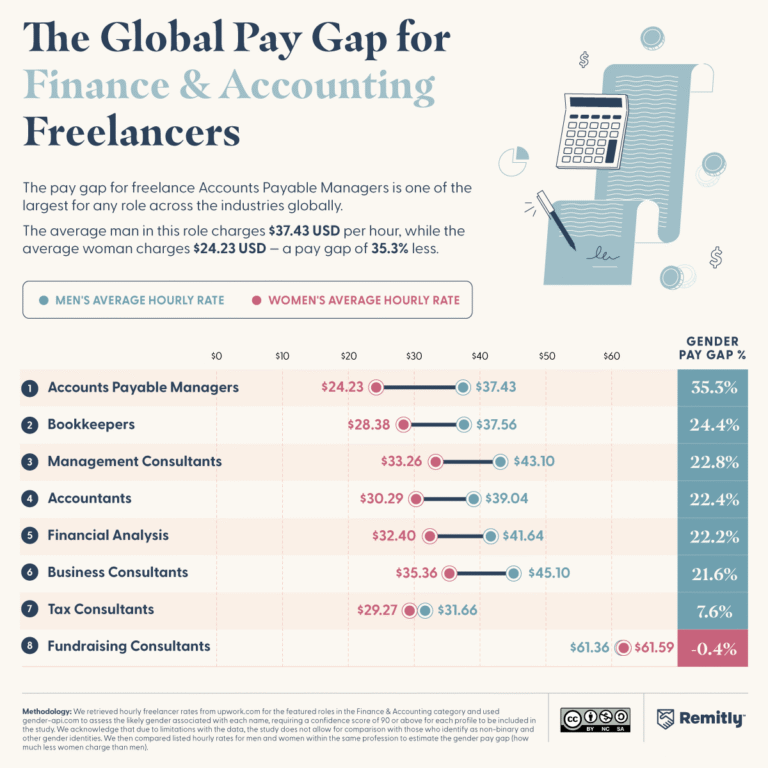
The numbers get even weirder when you look at specific job titles. You might think the gap shrinks as you get into highly specialized, process-driven roles. No, it actually gets wider.
Take a look at the hourly rate breakdown from the report:
| Freelance Role |
The Gap (Women vs. Men) |
| Accounts Payable Managers |
Women charge 35.3% less |
| Bookkeepers |
Women charge 24.4% less |
| Management Consultants |
Women charge 22.8% less |
| Accountants |
Women charge 22.4% less |
| Fundraising Consultants |
Women charge 0.4% MORE |
Shout out to the fundraising consultants out there holding the line, but for the rest of the profession, the data is a tough pill to swallow.
On average, a female freelance accountant is pulling in $30.77 an hour globally, while the guys are commanding $41.61. Why? Because in the freelance world, there is no HR department setting salary bands. You price yourself. And right now, women are pricing themselves at a steep discount.
The UK Reality Check
For years, the major UK firms have relied on a very specific defense whenever the annual statutory gender pay gap numbers drop. If you look at the Big Four or top-tier mid-market firms, the line is almost always: “Look, it’s a pipeline problem. We hire a 50/50 split at the graduate level, but our legacy partner pool is predominantly male. As they retire and more women move up, the gap will close.”
(For context, look at KPMG UK’s most recent 2025 figures their standard hourly median gap hovered around 15.7%, but once you factor in the massive partner distributions, the real earnings gap jumps significantly).
But the freelance market completely destroys the “pipeline” excuse.
When you’re an independent contractor, there is no partnership board blocking your promotion. There’s no old boys’ club controlling the bonus pool. You typed the number into your own profile. So why are highly qualified female UK accountants undercutting themselves?
Why Are We Undervaluing the Billable Hour?
If you talk to independent practitioners on the ground in the UK, this isn’t really about a lack of confidence. It’s about a structural trade-off.
Take a real-world scenario we see constantly in the UK market: a Senior Manager leaves a mid-tier firm after having her second child because the firm refuses to grant a true four-day week. She goes freelance to get her time back.
But when you need flexibility because you’re still balancing the lions’ share of childcare or domestic life, often forced to take “defensive pricing” positions.
-
The ‘Certainty’ Discount: To guarantee a contract that fits strictly into school hours (say, 10 AM to 2 PM), female freelancers will often underprice their bid to ensure they lock down the client immediately, rather than spending weeks negotiating a premium rate.
-
The Compliance Trap: High-margin freelance work (like acting as an interim CFO for a company going through a messy M&A deal) requires 24/7 availability. Because of the uneven distribution of domestic labor at home, many women default to lower-margin, highly transactional work like basic bookkeeping or tax compliance, where the hours are predictable but the rates are capped.
Knowing Your Worth
If our industry wants to talk about nurturing “Future Leaders,” we need to realize that flexibility without equity is just a trap. Right now, we are essentially telling women: “Sure, you can have your autonomy, but it’s going to cost you 26% of your earning power.”
As the UK freelance market continues to grow, fixing this isn’t just about telling women to “know their worth” or “charge more.” It requires small business clients and platforms alike to look at why they expect female expertise to come at a bargain. Until we fix the pricing psychology, freelance life isn’t an escape from the corporate grind, it’s just a mirror of it.