Private equity, agentic AI, and the new economics of European accounting
KPMG cut its own audit bill by 14 per cent last year, by arguing that AI should make the work cheaper.¹ The Big Four firm paid Grant Thornton UK $357,000 for its 2025 audit, down from $416,000, after telling its auditor to pass on automation savings or face a tender. When one of the world’s largest auditors prices AI into an audit fee, every sophisticated client will follow.
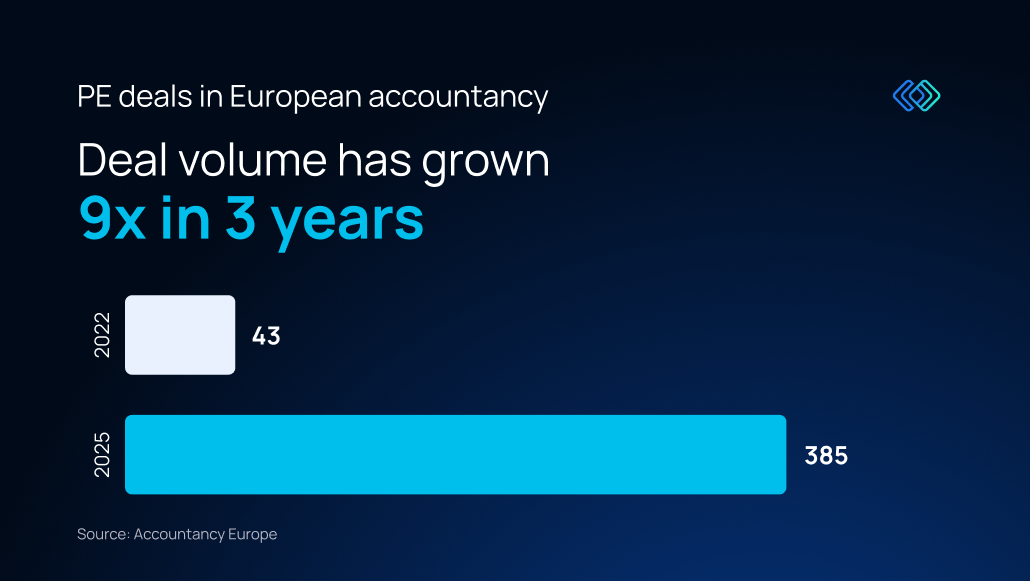
That is the demand side. The supply side is being bought. Private equity investors completed 385 transactions involving European accountancy and audit firms in 2025 — one every working day, and nine times the 43 deals recorded in 2022, according to Accountancy Europe’s transaction database.² A further 131 closed in the first four months of 2026. More than a third involved audit firms, despite EU rules that require statutory auditors to keep majority ownership and control.³
Together they change the position of every senior partner in Europe. Fees are repricing downward on AI assumptions just as your firm acquires a market price, whether you sought one or not.
The old math is finished
For fifty years the managing partner’s arithmetic was leverage: partners at the top, preparers at the bottom, hours in between. That model is breaking at both ends. Europe is short of accountants, and agentic AI — software that executes work rather than assists it — is removing the hours.
The buyers’ arithmetic is breaking too. The first wave of private equity platforms was built on multiple arbitrage: buy small practices cheaply, aggregate, sell the platform at a premium. That trade is maturing. Xeinadin, backed by Exponent, paused a £1bn auction after bids fell short; Sumer’s sale was delayed despite buyer interest.⁴
When aggregation alone no longer clears, what buyers pay for next is an operating model — margin that survives fee deflation, and capacity that does not depend on hiring people who do not exist. General partners are monitoring that development closely. The second phase of value creation in European accounting will be operational, and the operating lever is AI, agentic AI to be more precise. But only if the firm can deploy it inside the tightest regulatory perimeter in professional services.
Where the structures crack
EU law forces private equity-invested audit firms into split structures: an auditor-controlled audit entity and an investor-owned services entity, tied together by administrative services agreements.⁵ An AI agent does not inherently respect that wall. Trained on pooled platform data and acting across entities, it touches the independence, confidentiality, and conflicts obligations the legal structure was built to fence off. Solving it requires robust data governance, enhanced workflows, and technology that enforces policy seamlessly.
Regulators have noticed. The UK’s Financial Reporting Council and the Dutch AFM now ask for engagement before private equity transactions.⁶ The EU AI Act layers transparency and control obligations onto high-risk AI systems used in professional services contexts. The IAASB is reviewing how auditors govern complex models, data, and estimates under ISA 540 — the signal of where inspection findings go next.⁷
An ungoverned agent inside a private equity PortCo structure is not a technology risk. It is a regulatory finding waiting to be written — and for sure a discount at exit.
Firm AI: control as the asset
The answer is not less AI. It is governed AI, what we at Intapp call Firm AI: the firm rebuilt so agents can act safely in its name.
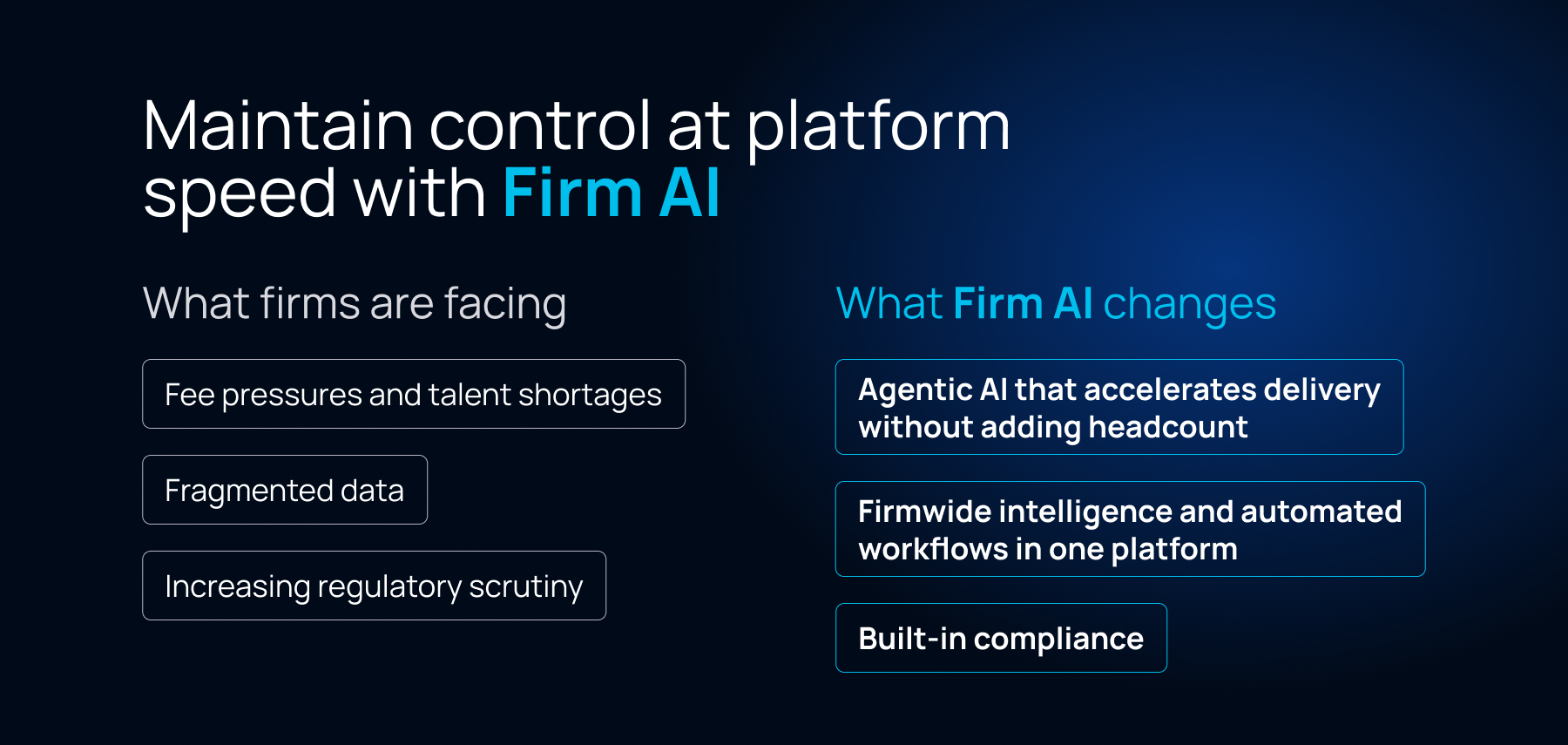
Three things distinguish it. One data foundation: client, engagement, relationship, and risk data unified across acquired practices, so agents reason from the firm’s knowledge rather than fragments of a dozen legacy systems. Governance by design: independence, conflicts, and entity boundaries enforced in the system rather than in the annex of a services agreement, with every agent action logged and auditable. And agents embedded in regulated work — intake, conflicts clearance, personal independence and engagement scoping — where Europe’s compliance burden is heaviest and the capacity shortage bites hardest.
The outcomes differ by seat. For the independent firm, Firm AI is how to match platform economics without selling. For the platform, it is the value-creation plan the first hold period never had. For the general partner, it is an exit multiple built on margin and provable control rather than aggregation.
Three decisions today’s partners owe tomorrow’s firm
The agentic firm will only be as good as the foundation it runs on, and three moves matter now.
- First, get your house in order before you scale: agents draw on the firm’s collective knowledge, and a data estate fragmented across acquisitions cannot be governed after the fact.
- Second, make AI oversight a leadership matter, not an IT matter — owned at board level, with decisions documented in a form regulators will accept, and done before the AI Act forces the timetable on you.
- Third, rethink what people do when agents do the preparing: fewer hands producing the work, more experienced judgment reviewing it — and a path to partner compelling enough to hold your best people, even under external ownership.
The capital will keep coming. The regulation will keep tightening. Brussels, the FRC, the AFM, and the IAASB all say so. What will separate the firm of the future from the merely acquired firm is the ability to prove control while moving at platform speed.
In Europe, governance is not the brake on the AI-enabled firm. It is the asset.
What remains uncodified is how any of this gets measured — outcome and profitability metrics are still unwritten, which opens a second discussion altogether: hybrid pricing and value management.

To discuss what Firm AI means for your firm — independent or platform-backed — contact tom.koehler@intapp.com.
⁴ Accountancy Europe, “Private equity in European accountancy and audit firms”, op. cit.
⁵ Accountancy Europe, “Beyond private equity”, op. cit.
⁶ Accountancy Europe, “Beyond private equity”, op. cit.
⁷ IAASB, ISA 540 (Revised) post-implementation review, public consultation survey, responses due 15 June 2026: iaasb.org