UK businesses are facing an unprecedented squeeze as HMRC ramps up its enforcement activity, with new data revealing a massive “crackdown” on VAT underpayments. Under pressure from Chancellor Rachel Reeves to close the multi-billion-pound tax gap, the Revenue is shifting from a policy of pandemic-era leniency to one of aggressive pursuit.
Analysis of recent HMRC data by Pinsent Masons and Lubbock Fine paints a sobering picture for the accountancy profession: investigations into large and medium-sized businesses have leaped by nearly a third, while late payment penalties have surged to over £300 million.
The Mid-Market in the Crosshairs
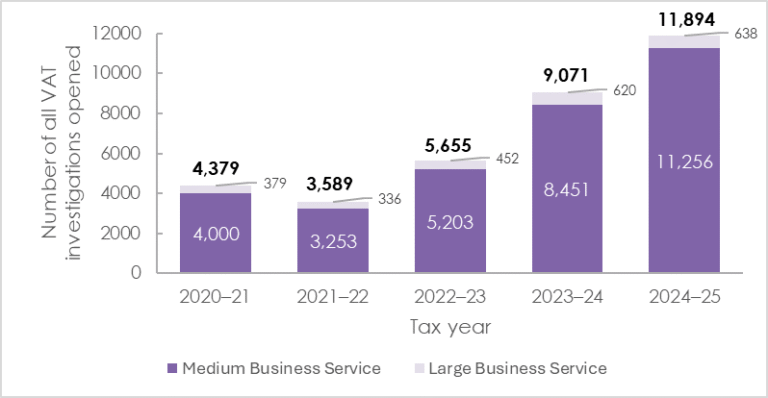
The most striking figure is the 31% surge in VAT investigations targeting large and medium-sized enterprises. In the year ended March 31, 2025, the number of inquiries jumped to 11,894, up from 9,071 the previous year. This is not a sudden spike but the peak of a steady upward trend; investigations have nearly tripled since the 2021/22 tax year, when only 3,589 cases were opened.
The focus is squarely on the “Medium Business Service” segment, which saw cases rise from 8,451 to 11,256 in just twelve months. Meanwhile, investigations into the very largest UK entities (Large Business Service) also ticked upward to 638. This isn’t just a broad-brush approach; it is a calculated hunt for high-value yields. For the UK’s largest companies, HMRC is currently extracting an average of £8.6 million per closed case.
“HMRC has got every encouragement it needs from HM Treasury to open more investigations and dig deeper,” says Bryn Reynolds, Partner at Pinsent Masons. “The amount of extra resource given to HMRC by the Chancellor is striking. It has led to almost one in three large companies facing a VAT investigation in the last year alone.”
The “Interpretation” Trap
For practitioners, the nature of these investigations is as important as the volume. HMRC’s data reveals that 85% of suspected underpayments by large businesses stem from “legal interpretation” or “pushing the boundaries” of VAT rules, rather than simple clerical errors.
With VAT law notorious for its complexity, HMRC is increasingly challenging businesses on how they apply specific exemptions or zero-rating. However, there is a bottleneck emerging: HMRC opened 12,000 more cases than it closed last year, suggesting the Revenue may be reaching the limits of its operational capacity, meaning investigations are likely to drag on longer, creating protracted uncertainty for clients.
A Double Whammy: The Penalty Peak
While the investigation teams are busy digging into records, the automated penalty regime is also hitting hard. Data from Lubbock Fine shows that HMRC issued nearly 582,000 fines for late VAT payments last year an increase from 569,000 the year prior. This resulted in a total penalty haul of £302 million, up from £294 million. This surge in volume correlates with a widening VAT gap, which HMRC estimates has grown from £8.9 billion to £11.4 billion, prompting the current aggressive recovery stance.
The rise in fines is also attributed to the 2023 penalty reform, which introduced a points-based system and more frequent financial hits. Under the current rules, businesses face a 3% penalty if VAT is 16 days overdue, doubling to 6% at the 31-day mark.
The Advisor’s Role: Proactive Mitigation
With HMRC investing £629 million specifically to bolster debt recovery, the days of “hiding in the sand” are over. The Revenue is currently sitting on a debt mountain of £42.8 billion, and VAT is a primary lever for recovery.
Jaspal Dhillon, VAT Partner at Lubbock Fine, stresses that for businesses struggling with NIC increases and rising operational costs, communication is the only defense.
“The first thing you need to do is make sure returns are filed on time and that you have requested a Time To Pay (TTP) Arrangement,” Dhillon advises. “It can be the difference between survival and failure.”
Analysis: What This Means for Accountants
This data signals a fundamental shift in the UK’s tax landscape. The Treasury views the top 50 businesses who account for £40 billion in VAT as the most lucrative targets, and they are arming HMRC with the budget to pursue them.
For accountants, this means:
-
Risk Profiling: Clients in the mid-to-large bracket must be warned that an investigation is no longer a “random” event but a statistical likelihood.
-
Audit Readiness: Given that 85% of cases involve “interpretation,” ensuring that the rationale behind VAT treatments is documented at the time of the transaction is critical for future defense.
-
TTP Strategy: As late payment fines become more regular, the threshold for entering Time To Pay negotiations should be lowered. Advising clients to wait until the “final notice” is now a high-stakes gamble.
As we move into the 2025/26 cycle, the message from the Treasury is clear: the VAT net is being cast wider, and the mesh is getting smaller.