MTD named biggest challenge (and opportunity) for accountants in 2025
New survey shows a profession split between pressure and promise as April 2026 deadline looms
New survey shows a profession split between pressure and promise as April 2026 deadline looms
With the 2026 rollout of Making Tax Digital (MTD) for Income Tax fast approaching, accountants are facing a turning point in the profession.
According to a recent Accountex survey, 81.7% of accountants view MTD as their biggest challenge in 2025. Yet nearly as many, 79.08%, also say it’s their greatest opportunity.
That duality captures a profession navigating a significant shift, not only in regulation but in culture.
For some, MTD brings increased compliance pressure and operational strain. For others, it opens the door to new revenue streams, deeper client relationships, and greater visibility into financial performance.
Biggest opportunities of 2025
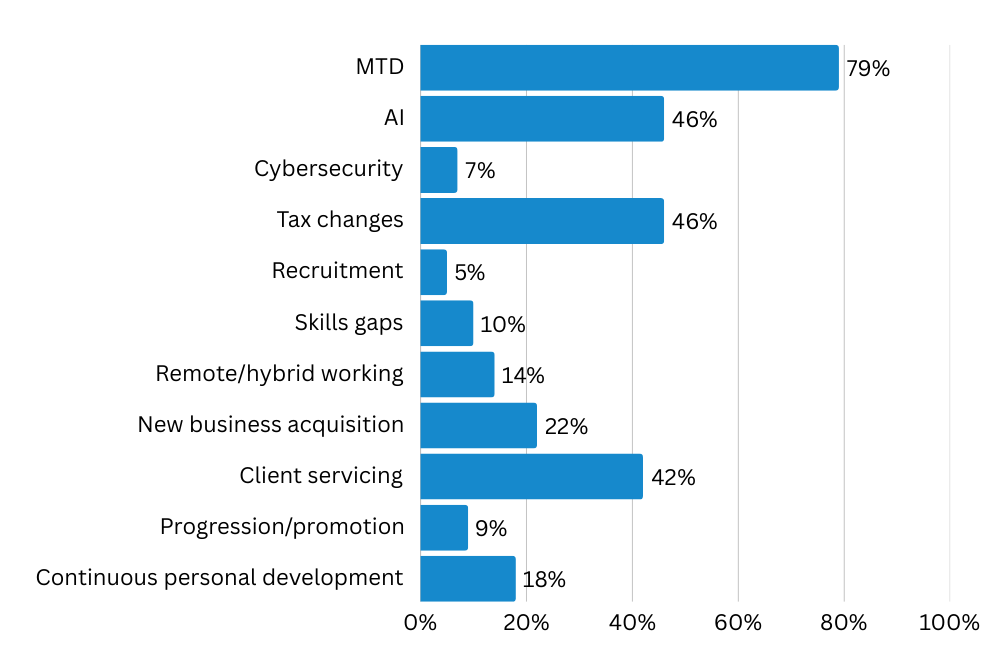
“MTD ranking so highly as both a challenge and an opportunity highlights how distinct this transition period will be for many in the industry,” said Caroline Hobden, Portfolio Event Director at Accountex.
“As we have seen with MTD for VAT, preparation is key, and accounting professionals at all levels should be spending this year researching the software available and understanding how their role will change with digitalisation.”
Biggest challenges of 2025
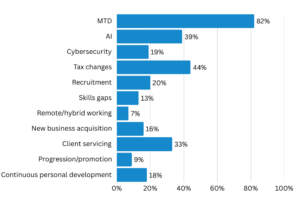
The next phase of MTD, scheduled for April 2026, applies to sole traders and landlords with income over £50,000.
While it promises long-term benefits, a third of accountants (34%) admit they’re not yet prepared.
Despite previous deadlines for VAT being largely successful, 11.15% of agents are still using the HMRC portal for filings-a method that will no longer be accepted above the threshold.
The workload implications of MTD are already prompting tough conversations across practices. Eriona Bajrakutaj, founder of Volt Digital Transformation, warns that a failure to adopt digital systems could leave firms overwhelmed:
“If you do not implement digital systems, you will need the extra capacity because we’re now going to see clients five times a year. I think managing client expectations will be a big challenge because it means clients will need to reframe their business model to ensure it can report in a digital format.”
“The biggest push back to be aware of is from your team. If they don’t want to go on the digital journey, it will hinder how fast you get there and how well you can service your clients. Try to involve your teams during every step of the process.”
Far from being just a compliance exercise, MTD offers firms the chance to reshape how they operate. Respondents highlighted more frequent client engagement, advisory upselling, and real-time data visibility as growth areas.
Digitalisation, when fully embraced, could allow accountants to shift their role from reporters to strategic advisors.
Chris Downing, Director of Product Marketing at Sage, sees MTD as an inflection point for how practices generate value:
“Not only will accountants support their clients in seeing the benefits and gaining visibility through real-time data… we’ll also see business owners reaching out to their agents to build stronger working relationships. Accountants and bookkeepers will be able to stay ahead of deadlines and begin seeing how AI will be a key factor in helping their practices become more profitable and generate new revenue streams.”
The Government is urging agents to act early. Craig Ogilvie, HMRC’s Director of Making Tax Digital, said:
“With April 2026 on the horizon, agents should now be reviewing if any of their clients have income over £50,000 from self-employment or property. We are issuing letters to customers we believe will be mandated… We urge those who meet the mandation criteria to join our testing programme on GOV.UK now.”
1 in 3 accountants not yet prepared for MTD

Joining that programme early, according to Clive Barnett, External Readiness Lead at HMRC, offers hands-on experience, and no penalties:
“Joining our MTD for Income Tax testing phase now gives businesses and agents hands-on experience before April 2026. Participants can prepare for this significant change with benefits such as dedicated support and penalty-free quarterly submissions.”
HMRC’s own data shows the upside:
The estimated value of time saved per year? Between £603m and £915m.
But success will depend on more than just signing up for pilot schemes. Firms will need to rethink their internal processes and team dynamics. MTD is not just a matter of software – it’s about buy-in, both from clients and staff.
As Hobden puts it: “Adapting to a new way of working will be a smoother process by learning from and sharing insights with others.”
Many accountants estimate that only 20% of clients will be affected by the 2026 threshold, but further phases in 2027 (£30k) and 2028 (£20k) will broaden the scope significantly.
That’s a fast-moving compliance timeline, especially for those who haven’t yet begun client outreach.